

Your first packaging shipment from Vietnam should not begin with a request for the cheapest unit price. A sourcing decision starts with a product that must work in a real operation: hold an item, run on a packing line, communicate a brand or survive distribution. The specification, supplier operating model and inspection plan need to support that outcome.
This guide is for importers, distributors and private-label buyers who need repeatable custom packaging, not just a catalog image. It explains what to confirm at each stage, what evidence to request and how to avoid three common problems: quotes built on different assumptions, samples that do not represent the order, and shipping costs that appear after the purchase decision.

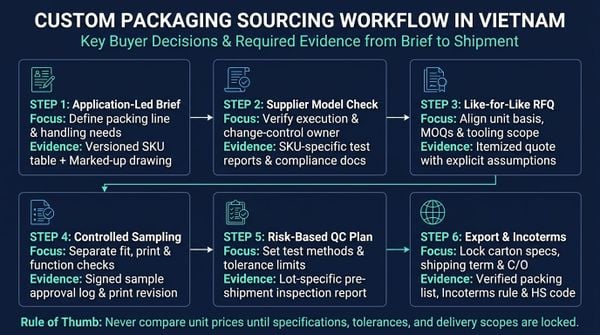
Figure 1. Buyer decisions when evaluating a custom packaging sourcing project.
1. Build a packaging brief around the job, not the material name
Describe the packaged product, target customer, route to market and handling conditions. A loose printed poly bag for spare parts and a bag dispensed from an automated packing station may use similar materials but demand very different opening, dimensions and tolerances. Say what must stay unchanged when the packaging is handled, filled or opened.
Start with one SKU table: product format, finished dimensions and measurement convention, material direction, opening or closure, printing, quantity per variant, inner packing and destination. Attach an existing sample or marked-up drawing if you have one. Mark unknown specifications as decisions to resolve rather than allowing a supplier to fill them silently.
2. Evaluate how the supplier will execute the order
A factory, trading business or sourcing coordinator can each be appropriate. The label does not explain who signs the commercial agreement, selects a production route, approves revisions or owns the response to a quality problem. Ask those questions directly. When production involves partner facilities, request clarity about inspection access, sample control and who communicates changes.
Check the relevance of supporting evidence, not the number of impressive-looking certificates. Any test, recycled-content document or regulated-use approval should match the exact material, construction and destination market. A general company claim is not proof that your particular packaging meets a requirement.
3. Request a comparable quotation with explicit assumptions
Send the same versioned brief to each shortlisted supplier. Ask for the unit basis, minimum quantity by SKU, what is included in printing setup, tooling, samples, standard packing, inspection and any agreed freight scope. A quote for 50,000 total pieces is ambiguous when the order contains five different artworks.
Ask suppliers to flag missing information and list their assumptions. For instance, 'pricing assumes one print design, one roll format and bulk-packed cartons' is useful; 'best price available' does not tell a buyer what is being priced. Commercial terms become a stronger comparison when the underlying specification is the same.
Typical Lead Times and MOQ Benchmarks in Vietnam
When planning your procurement calendar, factor in realistic production and transit windows rather than working backward from a best-case launch date. While exact schedules depend on material availability and order complexity, a standard first-order timeline in Vietnam typically follows these stages:
- Specification alignment & like-for-like quoting: 3 to 5 business days
- Cylinder/plate making & production-representative sampling: 7 to 14 days (gravure cylinders take longer than flexo plates)
- Mass production & in-line quality checks: 15 to 25 days after final sample sign-off
- Pre-shipment inspection, export packing & port drayage (Cat Lai / Hai Phong): 3 to 5 days
Understanding Minimum Order Quantities (MOQs):
In custom packaging, MOQs are rarely driven by assembly labor—they are dictated by raw material extrusion runs and printing setup waste. For custom-extruded poly bags or multi-color gravure printing, factories must run a minimum weight of resin (often 300 kg to 500 kg per film specification) to stabilize film gauge and tension. Converting that resin weight into unit counts explains why smaller or thinner bags require higher unit MOQs than heavy-duty liners.
4. Make sampling an approval process rather than an unrecorded conversation
A stock reference can show approximate material feel; a structural prototype can establish fit; a print proof checks artwork placement; a production-representative sample may be needed for function and finish. These are different kinds of evidence. Do not approve performance on the strength of a digital mockup.
Create a simple approval record containing sample ID, date, drawing version, artwork revision, accepted attributes and outstanding exceptions. If the sample is revised, change the version. This prevents one party using a previous print file while the other assumes the newest one was approved.
5. Agree on risk-based quality checks before bulk production
Choose checkpoints that reflect the intended use. Flexible packaging might require agreed measurement of width, length, thickness, seal or closure, print position and pack count. Wicketed bags might require a line-fit trial. Retail packs often require barcode, language and carton checks. Record the test method and acceptable range where relevant.
Clarify whether inspection happens before production, during a run, before dispatch or at multiple stages. The final record should identify the sampled lot, inspected characteristics, findings and resolution of deviations. Words such as '100% quality assured' are not a substitute for a product-specific inspection plan.
6. Finish with export packing and the named delivery term
Confirm carton quantities, shipping marks, labeling, weights and pallet requirements if applicable. A product can meet its dimensions yet arrive in unsuitable shipping packs for the buyer's receiving process. Packing is part of the quote, not a detail to discover after production.
State the Incoterms rule, edition and named place or port. FOB, CIF and EXW do not cover the same responsibilities. Freight, insurance, destination handling, customs and local delivery need to be considered according to the actual transaction. Do not infer duty-free entry based only on Vietnamese origin.
To qualify for preferential tariff rates under agreements such as EVFTA (EU), CPTPP (Canada, Australia, Japan, UK), or RCEP, your shipment must satisfy specific Rules of Origin—typically involving a Regional Value Content (RVC) threshold or a Change in Tariff Classification (CTC). Request confirmation during the RFQ stage on whether the supplier can issue the relevant Certificate of Origin (e.g., Form EUR.1, Form CPTPP, Form D/E) and verify that the harmonized system (HS) code on the commercial invoice matches your customs broker's classification in the destination market.
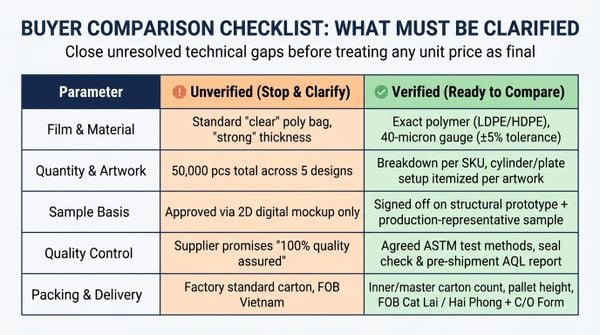
Buyer comparison: what must be clarified

Figure 2. Buyer comparison checklist: clarify requirements before evaluating supplier quotes (illustrative).
Use the matrix to close unresolved requirements before treating any unit price as final. A field marked 'pending' should trigger a clarification or representative sample, not an invented fact in the purchasing file.
BUYER WORKED EXAMPLE — THREE-SKU PRINTED PACKAGING ORDER
Consider an importer planning three bag sizes for one retail program. Two sizes use the same print design, while the third has a different barcode and pack count. The buyer should not ask for one blended unit price. Each SKU needs its own dimensions, material, artwork revision, order quantity, pack configuration and acceptance criteria. The quote should identify shared versus SKU-specific setup charges, any minimums per artwork, and whether inspection and export cartons are included.
A practical approval sequence is: freeze the versioned specification; request like-for-like quotes; approve a structural sample; approve a separate print proof; verify a production-representative sample when appropriate; then document pre-shipment inspection evidence. If a supplier proposes changing film thickness or carton count after quotation, treat it as a controlled specification change with a revised price and sample approval.
RFQ DATA MATRIX — COPY INTO YOUR PROCUREMENT BRIEF
Field | Buyer input | Purpose |
SKU / use | ID, product, use case | Prevent ambiguous quotes |
Dimensions | W × L × gusset; tolerances | Compare like-for-like |
Material | Polymer, thickness, seal | Define construction |
Artwork | Revision, colors, barcode | Control print changes |
Quantity | Per SKU and artwork | Clarify minimums |
Packing | Inner/carton quantities | Calculate landed cost |
QC | Critical tests and limits | Set acceptance basis |
Delivery | Destination, Incoterm, date | Clarify logistics |
SUPPLIER MODEL COMPARISON — QUESTIONS TO ASK
Model | Possible strength | Verification question |
Direct manufacturer | Visibility into production process | Which operations are in-house or subcontracted? |
Trading company | Consolidation across categories | Who handles specification changes and claims? |
Sourcing / coordination partner | Cross-factory coordination | Who approves samples, arranges inspections and reports exceptions? |
These are possible operating models, not a ranking. Ask for documented responsibility and evidence on the actual order rather than assuming one model always delivers better quality.
STAGE-GATE CHECKLIST FOR A FIRST ORDER
RFQ stage — Keep the specification revision and supplier assumptions in the quote file.
Sampling stage — Record sample ID, dimensions, print proof version and unresolved exceptions.
Pre-production stage — Agree the inspection plan, tolerance ranges, packaging and change-control owner.
Production / inspection stage — Request results tied to the agreed SKU, batch and measurement method.
Shipment stage — Confirm carton markings, packing list, shipping term and discrepancy resolution.
Repeat-order stage — Archive approved references and note any changes to material, artwork or supplier route.
PRODUCT SOURCING MATRIX — MATCH THE APPLICATION BEFORE REQUESTING PRICES
Product family | Buyer application | Specification questions |
Poly bags / liners | Retail, parts, waste | Material, dimensions, thickness, closure, pack count? |
Stretch film | Pallet stabilization | Hand/machine, width, gauge, roll weight, load? |
Garbage bags | Commercial waste | Bin fit, load, seal, roll format, dimensions? |
Reusable bags | Retail and promotion | Fabric, GSM, handles, printing, packing? |
These categories describe possible sourcing requirements, not verified Vietnam Packing stock or manufacturing capabilities. Link each family to its verified live product page before publication.
ILLUSTRATIVE QUOTE COST COMPARISON — BEFORE DUTIES AND TAXES
A buyer compares two hypothetical orders of 20,000 units. Offer A costs USD 0.080 per unit plus USD 300 setup, USD 450 freight and USD 150 destination handling: USD 2,500 total, or USD 0.125 per unit before duties and taxes. Offer B costs USD 0.090 per unit with setup included, USD 350 freight and USD 150 destination handling: USD 2,300 total, or USD 0.115 per unit before duties and taxes. The lower goods unit price does not produce the lower total of the listed costs in this example.
Use the same named delivery term and scope when comparing offers. Real calculations must account for freight allocation, inspection, insurance where relevant, import duties/taxes, currency and the rate of usable units. Do not treat the illustrative amounts above as Vietnam Packing pricing.
HOW TO USE THIS GUIDE WITH VIETNAM PACKING
For a project-specific inquiry to Vietnam Packing, request confirmation of the options and responsibilities relevant to your order. Send a versioned brief with drawings, reference samples if available, quantities by SKU and destination. Ask which product options can be quoted, what samples or supporting evidence are available, and who will coordinate specification approval. Contact: https://vietnampacking.com.vn/pages/contacts
BUYER DECISION CHECKPOINTS — WHEN TO STOP AND CLARIFY
If two quotations use different film gauges, artwork counts or delivery terms, do not rank them by unit price yet. Request a revised comparable scope. If a sample looks correct but lacks documented dimensions, mark its approval as conditional. If a material or regulated-use claim is commercially important, request evidence matching the specific SKU and intended destination market. If an inspection finds a deviation, agree on the disposition and recheck evidence before shipment release.
SPECIFICATION CHANGE CONTROL — EXAMPLE
Suppose a supplier proposes switching a 40-micron film to 35 microns to meet a target price. That is not merely a pricing adjustment: it changes a critical product parameter. The buyer should request an updated specification revision, sample or test evidence appropriate to the application, revised quotation and explicit approval before production. The same principle applies to zipper geometry, printing coverage, carton quantities and pallet pattern.
Frequently asked questions
Should I ask whether a Vietnam supplier owns a factory?
Ask about the operating model, but follow with the more important questions: who is contractually responsible, who approves specifications and who coordinates quality evidence. Ownership alone does not settle those issues.
How early should I request a custom sample?
Once the application and critical specifications are clear enough to evaluate it. First define whether you need a stock reference, structural mockup or production-representative sample.
Can one quotation cover several colors and sizes?
It can summarize them, but quantities, artwork and any minimums or setup costs should be itemized per variation so the buyer can compare offers accurately.
What quality testing standards should I specify for flexible packaging and poly bags?
Instead of requesting generic "high strength," reference internationally recognized testing methods matched to your application. Common benchmarks include ASTM D1709 (dart impact resistance for film toughness), ASTM D882 (tensile properties of thin plastic sheeting), and ASTM F88 (seal strength for flexible barrier materials). For food-contact or regulated retail packaging, specify compliance documentation aligned with FDA 21 CFR or EU 10/2011 before sampling begins.
What is the difference between flexographic and rotogravure printing for custom bags?
Flexographic printing uses flexible photopolymer plates, offering lower tooling costs and faster setup—ideal for simple logos, 1–4 spot colors, and medium order volumes. Rotogravure printing uses engraved steel cylinders, requiring higher upfront tooling investment and higher MOQs, but delivering superior photographic detail, consistent color across repeat orders, and lower unit print costs at high volumes.
Request a packaging quotation
Ready to source custom packaging? Send Vietnam Packing your product application, drawings or references, SKU quantities, artwork status and destination. Ask for a specification-led review and a quotation with explicit assumptions.
Contact / RFQ: https://vietnampacking.com.vn/pages/contacts


